
Most cultures conceal their magic within objects that masquerade as mundane things—rings, beads, thread knots. Korea conceals it within paper. Thin, yellow, and intentionally ephemeral, the boo-jeok (부적) is more “argument with fate” than “voodoo charm.”
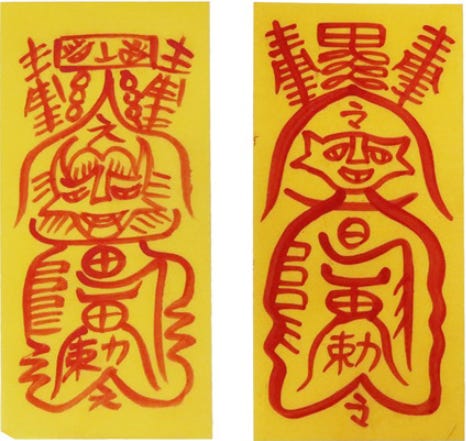
First impressions: the boo-jeok appears to be an unfinished piece. Brushstrokes are sloppy, symbols are strange, and the paper is thin enough to rip with a thoughtless puff of air. This is the intention. Unlike amulets meant to last an eternity, boo-jeok are like life itself: temporary, conditional, and dependent on belief and will.
Ink That Acts Like Magic
The boo-jeok is not a drawing; it is an action. Ink is typically cinnabar-red or black, applied to yellow paper that represents the earth and harmony. The symbols are not a decipherable script in the classical sense. They are cross-breeds—Chinese characters, shamanic symbols, and the individual improvisational flair of the mudang (Korean shaman) or monk who inscribes them.
This means that two boo-jeok, both used for the same reason—protection, luck, healing—are never the same. A boo-jeok is more like a signature than a recipe. It embodies the personality, experience, and spiritual power of the person who made it. In this way, it is less like an object and more like a signed contract with ink and faith.
Magic That Must Be Used, Not Displayed
In Western occult traditions, there is a tradition of preserving magic: lockets that have been worn for years, talismans that have been passed down through generations. Boojeok defies preservation. It is meant to be used up, burned, buried, or dissolved in water and drunk. Its magic is released through disappearance.
This disappearance is indicative of a central Korean belief: magic happens when things move. A boo-jeok stuck to a doorpost is magical because it protects a boundary. A boo-jeok burned at the end of a ritual is magical because the smoke rises. Even a boo-jeok dissolved in water and drunk is magical because the body becomes the final site of the spell.
Magic in this way is not about possession. It is about involvement.
Between Buddhism, Shamanism, and Common Panic
Boojeok thrives in the spaces between belief systems. You can find it in shamanic gut rituals, Buddhist temples, and, quietly, in wallets, phone cases, and exam notebooks. A student may not “believe” in spirits, but still carry a boo-jeok before a big exam. Not as a superstition, but as a safety net against the unknown.
This is its brilliance. Boojeok does not require a belief in gods. It requires only a respect for the unseen variables.
Boojeok in modern Korea is flexible without shame. Some boo-jeok are printed, mass-produced, even distributed online. Purists may turn up their noses, but boo-jeok was never about purity to begin with. It was about need. When something was important enough, people pulled out ink and paper.
Why Yellow? Why Paper?
Yellow is not just a color. It is a position. In East Asian philosophy, yellow is at the center—earth, harmony, mediation. Writing on yellow paper is a way of temporarily stabilizing chaos before attempting to address it. Paper, on the other hand, is porous, humble, and disposable. It will take in the intention and then release it.
A boo-jeok on stone would be hubris. A boo-jeok on paper is a negotiation.
The Quiet Reason It Still Exists
In a world of algorithms and data, boo-jeok persists because it is one thing that science can’t do: it gives form to fear. It turns fear into something that can be written down. Folded up. Burned.
And perhaps that’s why this yellow paper persists, even when it doesn’t work. Not every time, anyway. Maybe it’s enough to know that the universe has been notified.
Written by – Pallabi Dey
About the author –
As a part of this dynamic world, I am a tech explorer who is fueled not just by curiosity for code but also by diversified culture, cuisines, and flavors that paint our world. I also love writing content, painting and learning different languages that let me delve deep into the captivating aspects of cross-culturalism.