
“A piece of cloth,which is a symbol of national unity of Korea.”
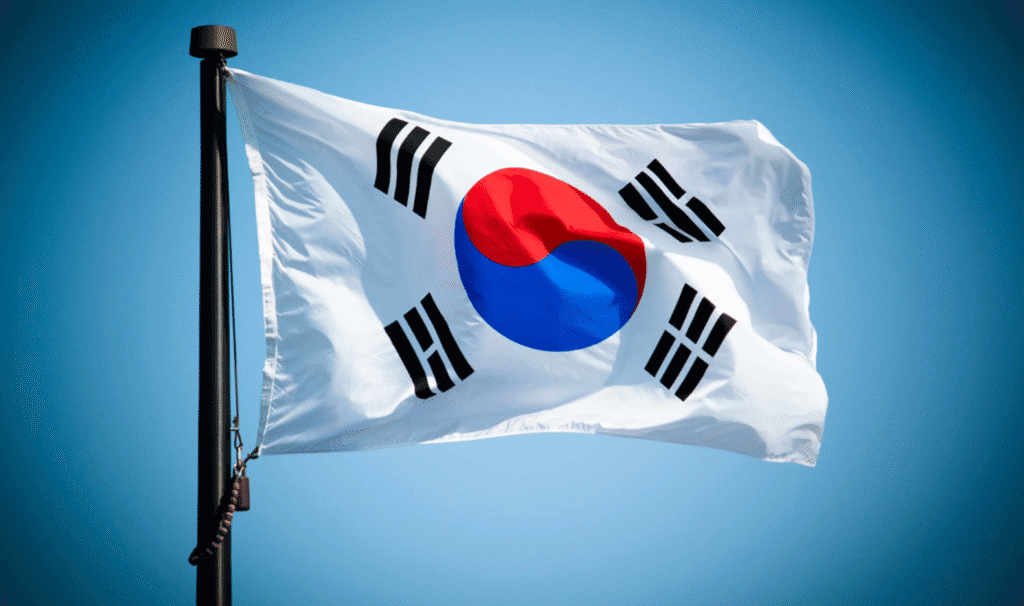
In Korean, 태극기 (taegeukgi) is the name of the South Korean flag. In August 1948, South Korea adopted this as its national flag. The flag has four black trigrams(the government), one in each corner, a red and blue(the people) “taegeuk” (like a yin-yang) in the center, and a white background(the land).
What is the 태극기(taegeukgi)?
covers color symbolism, visual components(trigrams, white field and central taegeuk circle), and nomenclature. Highlights the trigrams for the elements of nature-heaven, earth, water and fire-white for purity and peace, and red and blue for the cosmic balance of opposing forces.
What is Taegeuk?
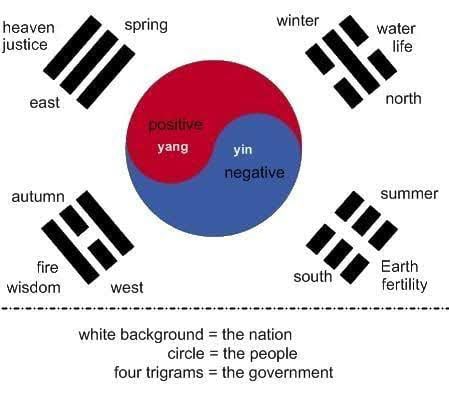
Explains the dualities-yang (red) and um/yin (blue), the constantly shifting but balanced forces that the flag symbolizes -that are the basis of the cosmological and philosophical symbolism. The ancient I-ching’s cardinal directions, seasons and principles are all connected to the trigrams.
History
1. Adoption and Origins(1882-1883) :
- Prior to 1882, dragons and phoenixes-Personal or royal symbols were frequently seen on Korean flags, signifying rulers rather than the country.
- In the late 1800s, the need for a national flag was sparked by diplomatic pressures, including treaties with the USA and Japan.
- In 1882, Korean officials, including King Gojong and Pak Yeong-hyo, created the Taegeukgi, which symbolizes balance and harmony by combining four trigrams from Taoist philosophy with the cosmic Taegeuk (red and blue circle).
- On January 27, 1883, the flag was formally adopted as the national flag after being flown in public for the first time in 1882 during a diplomatic mission to Japan.
2. Evolution:
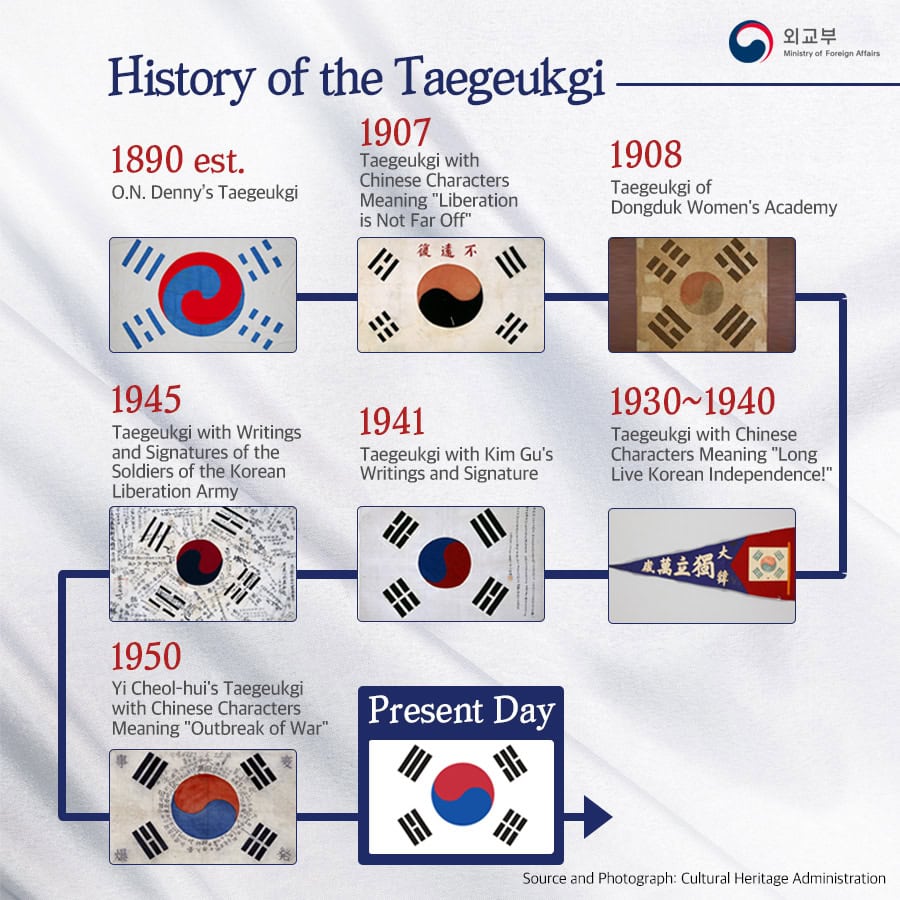
- Because design specifications were initially ambiguous, early iterations of the flag displayed variations in trigram designs, border colors, and taegeuk orientation.
- In treaties and diplomatic gatherings, the Taegeuki swiftly rose to prominence as a symbol of both national cohesion and international recognition.
- Despite being outlawed during Japanese colonial rule (1910-1945), proponents of independence continued to fly the flag.
3. Modern Period (1945 – Present):
- South Korea standardized the Taegeukgi’s design and reinstated it as its national flag following its independence from Japan.
- After briefly using a Taegeukgi inspired flag, North Korea switched its own Soviet inspired flag in 1948.
- The Taegeukgi was formally reaffirmed as the national flag by the Republic of Korea’s National Assembly in 1948. Subsequently, exact guidelines for trigram placement, color codes, and proportions were established.
Flag Symbolism
The Taegeuk represents universal balance, the trigrams stand for philosophical ideas and natural elements, and the white field represents peace and purity.
Written by – Sahinoor
About the Author –

My name is Sahinoor. I have a strong desire to learn a new language and culture whenever I get spare time. Despite being from a different culture, I have always been interested in other cultures. After watching Korean drama, I became very interested in Korean culture and life-style as a teenager. My passion for learning has given me a fantastic opportunity to write articles. I will be able to broaden my knowledge and discover a lot more about my cherished South Korea by writing articles.