
The ‘Haenyo’ of Jeju island, South Korea are one of the most enduring symbols of tradition in the country. Famous for their independent lifestyle and resilient heart, the Haenyo, or the ‘women of the sea’, are the community of divers found on the volcanic island of Jeju who have been working for centuries to sustain their families by diving into the ocean to harvest its produce.
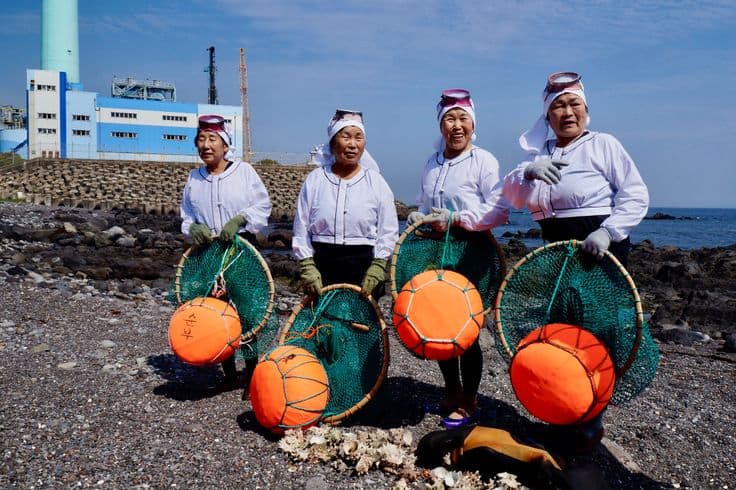
The origins of the Haenyo date as back as the 17th century, during the time of hardship for Jeju as most of the men on the island were either conscripted into the military or lost their lives in the sea while fishing. Additionally, the rulers of Korea imposed heavy taxes on the earnings of the men, but exempted the women. This pushed the women towards the sea, forcing them to take up the role of the breadwinners of the family and ultimately, shaping the society and culture of Jeju.
This social system initially began as a means of survival, transformed into a semi-matriarchy society. Only girls were trained to master the dangerous job of freediving and become a Haenyo, collecting abalones, sea urchins, sea weeds, conch, etc. from the sea. These girls often started training young as this profession is considered mentally and physically exhausting. Some start as early as ten to learn how to dive as deep as 20 meters, without oxygen tanks, protective gears or equipment, mostly relying on weights and goggles.
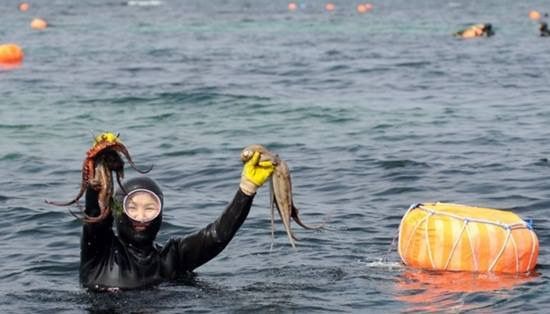
The Haenyo spent up to 7 hours per day in the sea, with each dive lasting 1-2 minutes. After a dive, they come up to the surface to exhale and emit a whistling sound called ‘sumbisori’ that helps them to regulate their breathing and also works as a signal to ensure their safety.
Generations of experience in diving have led them to create an intimate relationship with the sea. Their understanding of the ecology is impressive, helping them to identify marine life and navigate water currents and tides as well. They practice sustainable fishing and have strict rules in their community about what can be harvested and when. For example, they avoid catching certain fishes during the breeding season and instead go for sea weeds. They also avoid conches that are smaller, thus allowing them to fully grow and reproduce before being harvested.
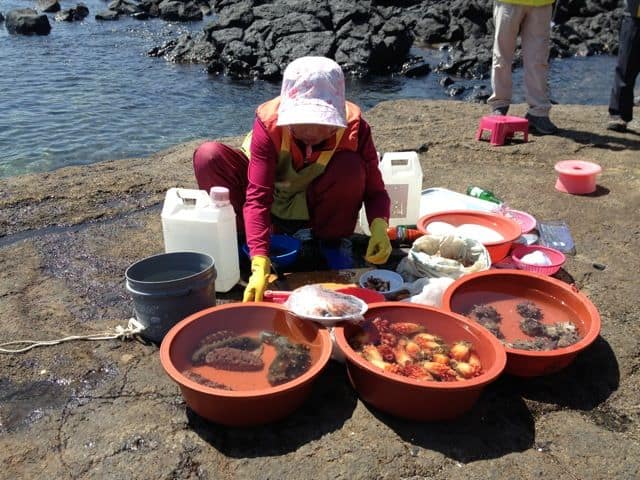
Their approach reflects a connection and respect for the ocean, their provider, as their survival is tied up with its condition. Fortunately, Jeju island has a thriving marine life due to its volcanic coast and clear water. However, protecting the ocean is an important part of the community, and it is with the traditions of the Haenyos and their age-old wisdom being passed down that the resources have been kept alive for so long.
The practices of the Haenyos are passed down and managed through their internal hierarchies, divided into three levels, based on expertise. The newer ones are called ‘hagun’, then comes the ‘junggun’, and finally, the master is the ‘sanggun’ who leads the community and guides the younger ones. The Haenyos have some practices like gathering before every dive to pray to the goddess of the sea, the ‘Jamsugut” for their safety and a fruitful harvest.
There’s no doubt in the fact that the work of the Haenyos is extremely risky and exhausting, despite their resilience and skills. Thus, these divers have slowly been disappearing as the younger generation tend to prefer jobs in different sectors like tourism, or are more focused on getting their education and moving out to urban areas. As this profession was born out of necessity in the past, these youngsters started opting for safer jobs, thus, the active Haenyos left are mostly between 60-80 years old. They consider themselves as the last Haenyos of their generation as their numbers are dwindling each year.
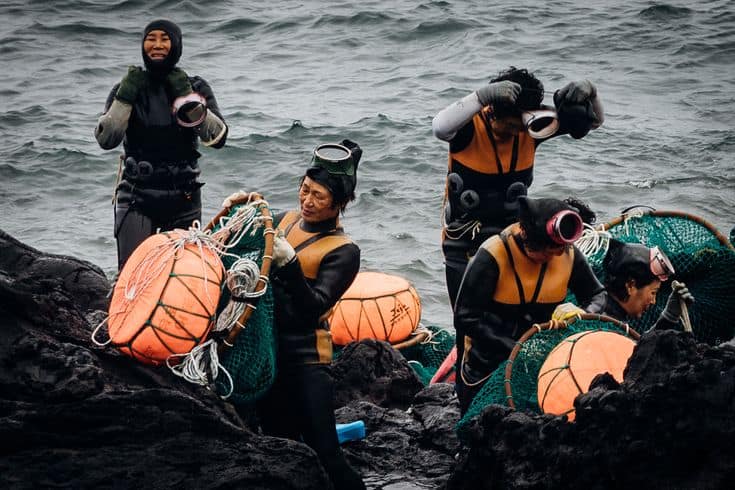
Even though this livelihood shows a significant decline, the Haenyos have now become one of the most recognised cultural icons of South Korea and are being talked about and celebrated in documentaries, art, dramas and exhibitions to talk about their strength and relationship with the ocean. In 2016, they were recognised on Jeju’s ‘Representative List of the Intangible Cultural Heritage of Humanity’ by UNESCO for preserving the marine ecosystems and showing remarkable community driven cooperation. The Haenyos are thus no less than the living heritage of South Korea.
Written by – Priyanjana Jha

About the Author –
Priyanjana is a post graduate in Global Studies, with a research background in feminism and cultural studies. Her interests lie in exploring themes related to cross-cultural relations, history and gender identities, with a particular passion for Korean culture and society. She is actively learning the Korean language and sees writing as a way to bridge cultural gaps in the world, and share her stories with others. In her free time, she loves to watch K-dramas and make K-pop dance covers.