
Before buttons and zippers, Koreans fastened their clothes with silk and patience. In a single, perfect knot, they tied together beauty, belief, and generations of meaning.
The Thread That Holds Everything Together
There is a photograph from the 1930s. In it, a Korean woman in hanbok stands beside a stone wall, her gaze soft, her posture elegant. But it’s not her face that draws the eye. It’s the ornament hanging from her jacket, a cascade of silk cords, intricate knots, and a tassel that catches the light. The norigae (노리개) moves slightly, as if still swaying from her breath.
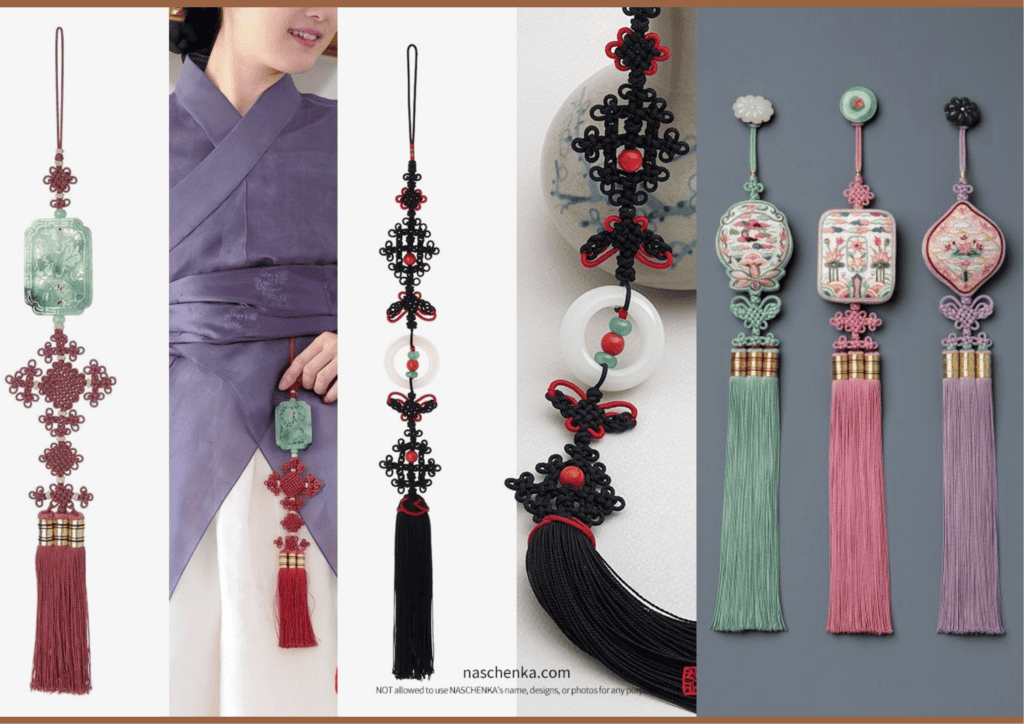
That tiny cluster of knots contains a universe. Every loop was tied by hand. Every color was chosen with intention. Every shape, a chrysanthemum, a butterfly, a plum blossom, carried a wish for longevity, happiness, or love. The woman wearing it may not have known the name of the artisan who made it. But she understood, without being told, that she was adorned not just with silk, but with centuries of meaning.
This is the world of Maedeup (매듭)- Korea’s traditional art of knotting. It is delicate, demanding, and deeply philosophical. And today, it is quietly disappearing.
Chapter 1: The Knot Before the Knot
Long before maedeup became art, it was survival.
Archaeological evidence shows that, as far back as the Neolithic period, inhabitants of the Korean peninsula used knots for purely practical purposes, such as fastening stone axes, mending fishing nets, and carrying tools. Garak-bakwi, primitive tools used for sewing and knotting, have been excavated across Korea, their tiny holes evidence of thread passed through and secured.
For millennia, a knot was simply a solution. You tied it because you had to. You tied it to hold, to carry, to survive.

But something shifted during the Three Kingdoms period (37 BCE – 668 CE). A tomb painting from 357 CE in Goguryeo shows a nobleman with decorative knots adorning his belt and the banners around him. For the first time, Koreans began to see beauty in the knot. The practical had become aesthetic. The useful had become meaningful.
By the time of the Goryeo dynasty (918–1392), maedeup had fully emerged as a decorative art. Buddhist paintings depict ornate knots adorning robes and ritual objects. A celadon vase from the period shows the impression of a knot pattern, forever frozen in jade-green glaze. The knot had transcended function. It had become a form of expression.
Chapter 2: The Golden Age of Silk and Status
The Joseon dynasty (1392–1910) was Maedeup’s golden age and also its most rigid.
In the Confucian social order of Joseon, everything had its place. Clothing signaled status. Adornment followed strict rules. And maedeup, precisely because it was so visible, became a marker of rank. The royal court employed dozens of specialized artisans. Some boiled and dyed the silk threads. Others twisted them into cords (kkeunmok or dahoe). Still others, the maedeupjang (매듭장), tied the knots themselves. Senior ladies-in-waiting (sanggung) at the palace also practiced the craft, their nimble fingers producing ornaments for the royal family.
Outside the palace walls, women of the yangban (aristocratic) class learned maedeup as an essential domestic skill. A well-tied knot demonstrated not just dexterity, but discipline, patience, and an understanding of tradition, all highly valued virtues in a Confucian bride.

The most common and beloved application of maedeup was the norigae, a decorative pendant worn by women of all classes on their hanbok. A norigae was more than jewelry. It was a personal statement, a talisman, and often a family heirloom. The choice of knot, the color of the tassel, the precious stone at its center all conveyed something about the wearer: her status, her hopes, her beliefs.
A bride might receive a norigae featuring the Dongsimgyeol (동심결) knot, a name that means “binding two hearts forever”. This knot, with its interlocking loops, symbolized eternal love and was worn as a wish for a harmonious marriage. At funerals, the same knot could appear, its meaning shifting from romantic union to the soul’s eternal rest.
Chapter 3: The Language of Loops- Understanding the Knots
There are 38 basic types of Korean knots, though variations and regional interpretations multiply that number many times over. Each has a name, a distinct shape, and a symbolic meaning. Together, they form a visual language that any educated Korean of the Joseon era could read at a glance.
The Gukwa knot, the chrysanthemum, is perhaps the most recognizable. When tied in mauve and plum threads, it represents autumn and eternity, the flower’s many petals suggesting the endless cycle of life and death. The Maehwa knot, shaped like the five-petaled plum blossom, celebrates the first flower of spring, a symbol of resilience and hope.
What distinguishes Korean knots from their Chinese and Japanese counterparts is their three-dimensionality and tightness. Chinese knots tend to be flatter and more pattern-based. Japanese knots are looser, almost airy. But Korean maedeup is dense, structured, and perfectly symmetrical, the same shape front and back, a feat of engineering as much as artistry. Korean knot can be described as a craft, with traditional maedeup described as “balance and order perfected by a reserved beauty”.
Chapter 4: The Unraveling
The 20th century was cruel to maedeup. Under Japanese colonial rule (1910–1945), policies designed to obliterate Korean culture pushed traditional crafts to the margins. Western clothing, with its buttons and zippers, began to replace hanbok in daily life. Why spend hours tying a silk knot when a factory-made button works faster?
After liberation, the pace of change only accelerated. Machines could now produce cords (dahoe) in minutes of work that once required days of hand-twisting. The generational transmission of cord-making skills was disrupted, and many techniques were lost.
By the 1960s, maedeup had become a rarity. The knots that once adorned kings and commoners alike were seen only in museums, on the robes of shamans, or as heirlooms pulled out for special occasions. The language of loops was being forgotten.
Chapter 5: The Knot Reimagined
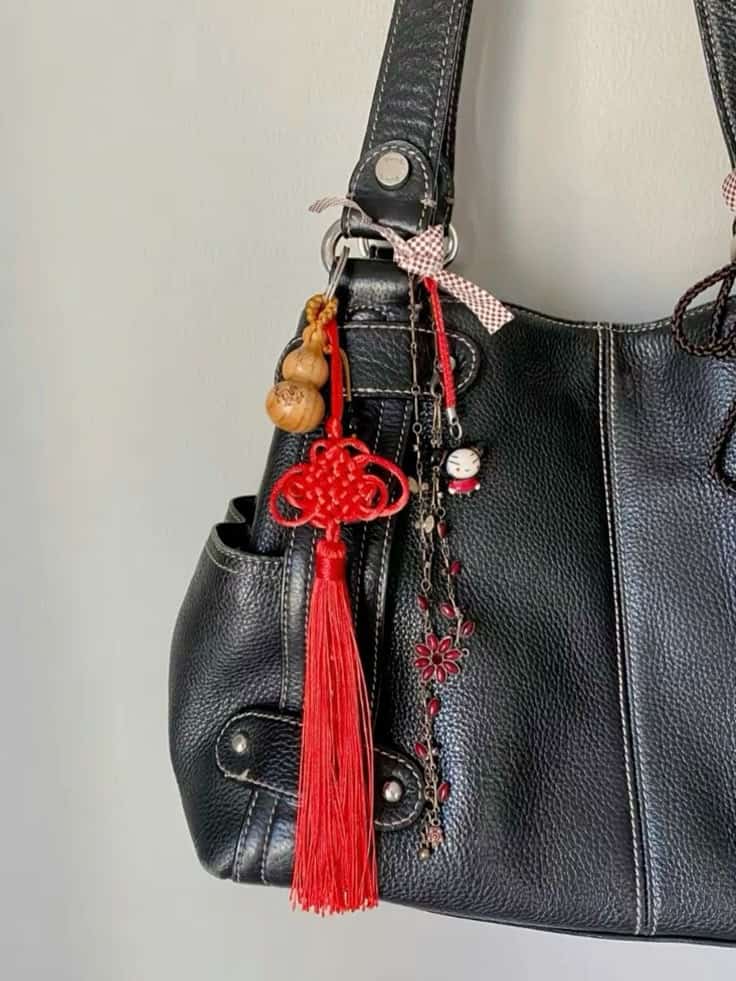
In recent years, maedeup has found unexpected new life. Contemporary designers are incorporating traditional knots into accessories, jewelry, and home décor. Phone charms, earrings, bookmarks, and keychains, small, accessible items, have introduced maedeup to a new generation. Young Koreans who might never wear a norigae are discovering the pleasure of a hand-tied bracelet.
Fashion has also embraced the craft. In 2024, Italian luxury house FENDI collaborated with Korean maedeup master Kim Eun-young for its “hand in hand” project. The result was a limited-edition Baguette bag adorned with traditional knots, including a mangsu technique once reserved for royal garments. The bag’s colors, subtle ochres and grays, were achieved through natural dyeing processes using acorns and arrowroot, a nod to the eco-conscious wisdom of traditional artisans.
Pop culture has played its part, too. In the 2025 animated film “K-Pop Demon Hunters”, a Korean character gifts her friends a bracelet featuring a Gukwa knot. For viewers unfamiliar with maedeup, it was a tiny, beautiful mystery. For those in the know, it was a message about the enduring power of cultural symbols.
Even BTS has gotten involved. During a 2025 appearance at Vogue World, member V wore a red silk cord around his waist, a modern interpretation of a traditional accessory, worn as Korean men once did.
Across the world, artists are discovering maedeup. French textile creator Aude Tahon trained for three years with a Korean master and now produces knotted works that blend French aesthetics with Korean technique. She describes the process as meditative: “When I knot, there’s a rhythm to it, something redeeming”.
Chapter 6: Tying Your Own-How to Experience ‘Maedeup’ Today
For those who wish to go beyond appreciation to participation, opportunities exist.
In Seoul, the Donglim Knot Workshop in Bukchon offers classes ranging from single sessions to year-long intensives. Students learn not just knotting, but the entire process from dyeing silk to twisting cords. Korean Cultural Centers around the world, including those in Paris and London, periodically host workshops.
For beginners, the Dongsimgyeol knot is a perfect starting point. Simple enough to master in an hour, yet meaningful enough to feel like an accomplishment. It requires only a single cord, patience, and the willingness to fail a few times before succeeding.
Online tutorials, many in Korean, are proliferating. A search for “maedeup” on YouTube or Instagram reveals a growing community of enthusiasts sharing their work, their mistakes, and their triumphs.
Chapter 7: What We Lose When a Knot Is Forgotten
Why does any of this matter? In a world of mass production and instant gratification, why spend hours tying a single knot by hand?
Because maedeup teaches something that cannot be learned from a screen. It teaches patience. A single mistake means unraveling everything and starting again. There is no shortcut, no undo button. Only the slow, repetitive work of getting it right.
It teaches balance. The perfect knot is symmetrical, front and back identical. Achieving that symmetry requires constant adjustment, a mindfulness that extends beyond the hands to the mind. It teaches connection. Every maedeup piece is made from a single continuous thread. The entire object, knots, loops, tassel, emerges from one unbroken line. There is a philosophy in that: the idea that all things are connected, that the beginning and end are one.
The Thread That Remains
The woman in the 1930s photograph is long gone. Her name is lost, her story forgotten. But the norigae she wore the cascade of silk, the perfect knots, the swaying tassel still exists somewhere. Perhaps in a museum. Perhaps in a family chest. Perhaps in the imagination of a young designer seeing it for the first time.
That is the power of maedeup. It outlasts its makers. It carries meaning beyond its moment. It connects us, through silk and patience, to hands that worked centuries ago. The knots are tighter now. The colors are sometimes synthetic. The contexts have changed. But the thread remains unbroken. And if you sit quietly with a length of cord, your fingers learning the old patterns, you might feel it too the presence of all those who tied before you. The grandmothers and court ladies, the shamans and brides, the masters and apprentices. They are there, in every loop, in every tassel, in every knot that still, after all these years, holds.
Because a knot is never just a knot. It’s a promise. A wish. A memory. A thread connecting us to everyone who ever tied one before.
Article Compiled & Written By: Trisha Deka
About the Author –
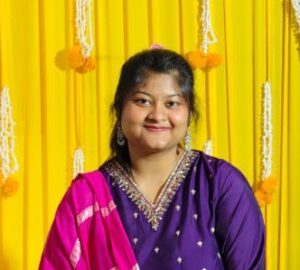
Think of Trisha as your modern-day storyteller for a dynamic culture. She’s got a sharp eye for the moments where tradition and hyper-modernity collide in Korea. One minute, she’s breaking down the latest digital trends from Seoul, and the next, she’s explaining the timeless ritual of a tea ceremony. Her writing is your front-row ticket to understanding not just the “what” of Korean culture, but the “why” that makes it so captivating.