
Women across cultures and historical periods have faced systemic oppression and subjugation, however, some form of resistance has always existed. Fueled by collective dissatisfaction and outrage, ‘feminism’ arose as women refused to accept the oppression and denial of their fundamental rights and liberties.
The term “feminism” was first coined in 1837 by the French utopian philosopher and radical socialist Charles Fourier and soon became an umbrella term for numerous belief systems, thoughts, theories, and morals. Unlike Western feminist movements that gained momentum quite early, Korean feminism was historically sidelined by what were deemed as more pressing concerns of national interests including liberation from Japanese colonialism, modernization, reunification, and democratisation.
The Japanese occupation in the 1910s served as an initiation for women’s activism, laying the foundations for future women’s emancipation movements. While feminist consciousness began emerging in the 1920s-1930s, autonomous women’s organizations were not fully visible till the 1970s.
Early feminist efforts in Korea, such as the ‘New Women’ or the shin yeoseong directly challenged the patriarchal Confucian ideology of women as wise mothers and good wives. Many working women from various backgrounds like rural farmers, urban factory workers, and sea women (haenyeo) organized strikes against harsh labor conditions and Japanese occupation.

However, nationalist movements restricted these efforts and suppressed their activism to prioritize liberation struggles over women’s resistance, resulting in the sidelining of their resistance.
After Japan’s colonial rule ended in 1945, groups like the ‘Founding Women’s Association’ emerged to advocate for voting rights, equal pay, and education for women but soon collapsed due to growing ideological divide between communist North and capitalist South. In the 1950s, the need to improve women’s rights was once again overshadowed by the need to rebuild and modernise the country due to the unstable situation in the country caused by the Korean war.
The following decade saw worsening of gender inequalities under the authoritarian military regime of General Park Chung-hee. The General suppressed any type of dissent or protest, labelling the protesters as ‘red commies’ to justify their suppression. Instead, state-approved, conservative, right-leaning women’s organizations emerged at that moment. Groups like ‘Korea Church Women United’ (1966) and Korean Federation of Housewives’ served primarily as tools for propaganda and worked to support the activities of the regime, like promoting campaigns for birth control and anti-communism.

The growing feminist activism in 1960s-70s South Korea is largely associated within the broader framework of ‘minjung undong’ or the people’s democracy movement. It worked against the exploitation of young female factory workers. During this period, the South Korean economy took off and relied heavily on overworked workers who worked in crowded spaces among which, 80% were women. Some as young as 13, had to sacrifice their education to support families. Thus, marking the beginning of the feminist labour moment.
A landmark development came into action in 1977, when the Korean Women’s Institute (KWI) was established under Ewha Womans University, making it the first research institute in the country and setting up the first master’s degree program in women’s studies in Asia. The following decade saw feminism gain widespread popularity in South Korea as the democratization movement grew in the country. In 1987 the first presidential election after the democratization was held, coinciding with the establishment of the Korea Women’s Associations Union (KWAU), an influential organization that fought to combat sexual violence against women.
By the 1990s, the women’s movement saw a gradual increase in institutionalization as feminist organizations formally registered with the state to secure funding and influence policies. This could happen as the progressive governments facilitated “state feminism,” and supported the rise of feminist NGOs. These methods saw significant progress as activists consciously distanced themselves from male-dominated progressive movements and the country witnessed the rise of a “campus feminism’. Many young university students raised their voices against patriarchal norms and oppression and led independent campaigns.
These student spaces enabled women to raise their voice against the sexual violence cases, which were earlier seen more as violations to female ‘chastity’ than a human rights issue. Later on, the goals for these feminist groups evolved into a fight for autonomy and key agendas like addressing the ‘comfort women’ issue and increasing women’s political involvement.
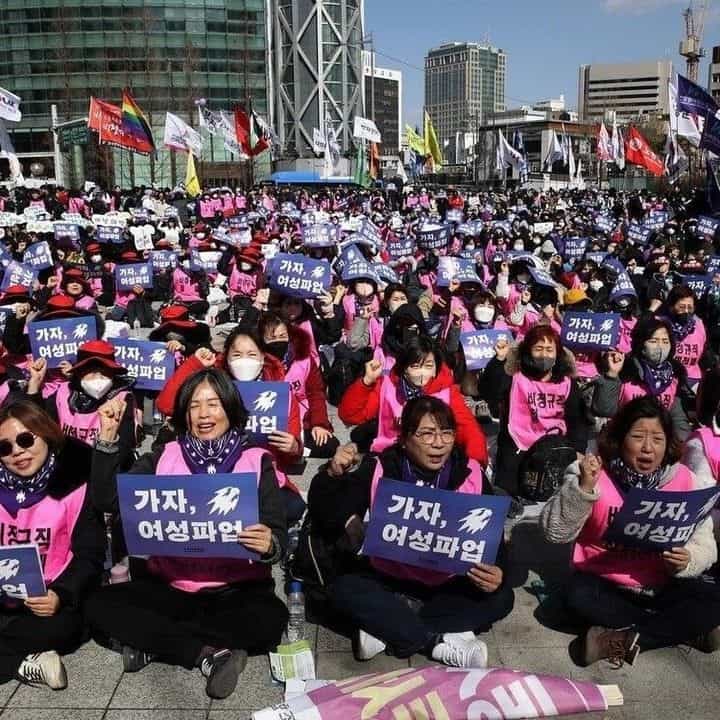
The post-Cold War era brought significant ideological shifts in Korean feminism as the activists moved towards issue-specific reforms. Due to the predominant Confucian culture, the activists carefully put aside issues of female body and sexuality. The institutionalization of the movement helped to promote gender mainstreaming in national policies through the establishment of the Presidential Committee on Women’s Affairs in 1998, which expanded into the Ministry of Gender Equality in 2001.
Gradually, South Korea experienced a neoliberal feminism as it witnessed the entry into global capitalism that promoted values of independent competition and profit making. Korean women became assertive and competitive and no longer accepted systemic oppression, whereas young men struggled to adapt to the fast paced, neoliberal society of intense competition all while their privileges and hegemony over women were diminishing. This created a greater gender divide and rise in misogyny among men as they tried to live through the power imbalance.
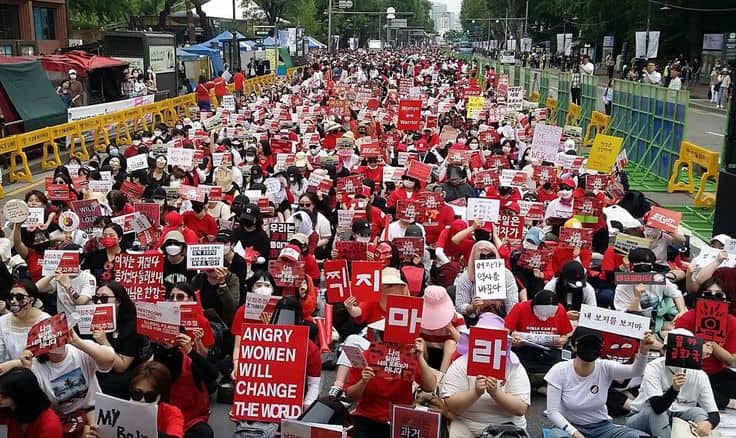
In recent times, as a response to the growing misogyny, South Korea has witnessed a rise in feminist resistance, termed as a ‘reboot’ that aligns with the fourth wave of global feminism. This reboot saw the rise of digital feminism and adoption of radical approaches to dismantle systemic inequalities. These feminists rejected conventional ethics and norms to create a movement exclusively for the liberation of women, leading to the emergence of the ‘4B movement.’ The 4B movement advocated for a complete refusal to engage with any type of patriarchal institution or relationship with men like marriage, dating, childbirth or heterosexual sex. While doing so, the women aimed to escape from the shackles of patriarchy, beauty capitalism, violence, and neoliberal gendered expectations.
Written by – Priyanjana Jha

About the Author –
Priyanjana is a post graduate in Global Studies, with a research background in feminism and cultural studies. Her interests lie in exploring themes related to cross-cultural relations, history and gender identities, with a particular passion for Korean culture and society. She is actively learning the Korean language and sees writing as a way to bridge cultural gaps in the world, and share her stories with others. In her free time, she loves to watch K-dramas and make K-pop dance covers.