
In an industry built on visibility, volume and velocity, Taehyung’s discography feels like he’s breaking through walls. Refusal to overproduce, refusal to overshare and refusal to run on speed. In fact, one of the most interesting things about his music is that it is steady and slow. And, to understand his discography, one has to start with his taste.
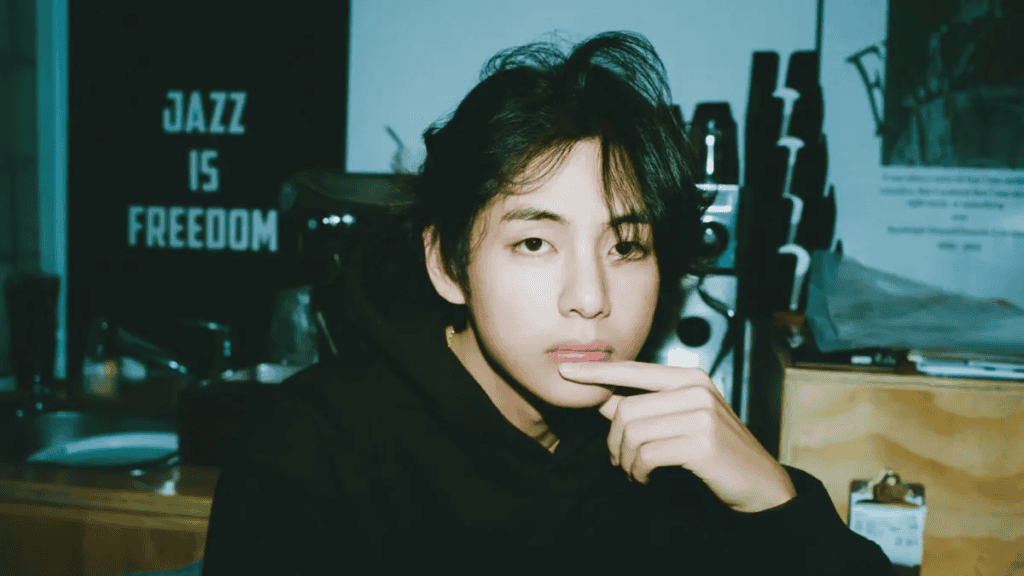
Before Layover, and before curated visuals, and mood promotions, there were songs like Scenery, Winter Bear and Snow Flower. They were produced and put out without the infrastructure of a debut rollout and were already a blueprint of what would follow. These tracks had a personal and intimate tone to them. Soft keys, minimal percussion and minimal attempts with vocal acrobatics or chart chasing.
Taehyung’s love for jazz is known to be deeper than instrumentation. In his solo work, you hear the philosophy more than the genre itself. His voice rarely dominates a track, instead, it blends into the arrangement, disguising itself as another instrument among many. This is fully realised in Layover, an album that leans into R&B and has a jazz inflected soul with slow beats, uniform tuning and frequent saxophone appearances. Through it all, there is a space between every element which creates a listening experience that feels grounded.
Layover works because it is not a collection of singles engineered for different moments, but a body of work designed to be heard and perceived together. That tracks bleed into one another tonally and his visual direction also mirrors this choice. Muted palettes, vintage references and slow camera movements makes the styling feel archival rather than futuristic.
Part of what makes Taehyung so compelling is not just the music, but how ambiguous he is. The enigma is not a mystery for marketing, and his songs leave room for emotional interpretation. Even in OST work like Sweet Night and Christmas Tree, the approach remains the same. These songs support scenes rather than dominate them and create an environment which allows feelings to build.
Taehyung’s personal style reinforces the same philosophy. He gravitates toward tailored silhouettes, muted tones and retro references. Nothing feels performative in the loud sense, and his fashion choices emphasise shape, proportion and detail. Like his music, his style demands attention. And the consistency between his discography and visual presentation suggests a unified artistic identity. It is an identity someone is curating carefully.
His Tiny Desk Korea appearance did not attempt to repackage the songs into louder, more broadcast friendly versions. The band setup felt organic rather than theatrical, with live instrumentation foregrounded in a way that emphasized warmth and tonal balance. The arrangement choices allowed the room itself to participate in the performance. You could sense that the objective was not to impress an audience with scale, but to invite them into the temperature of the music, to feel its weight in real time.
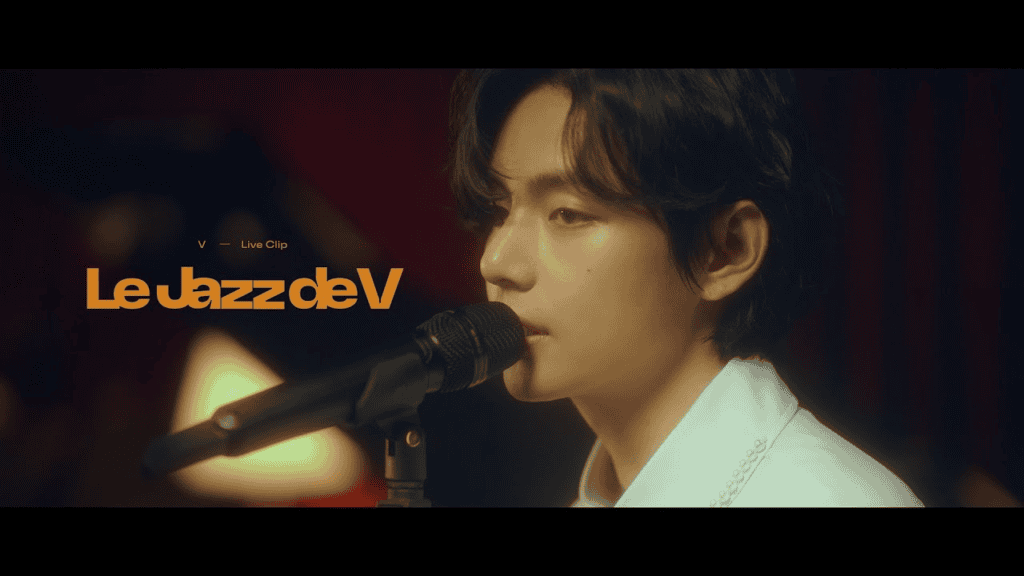
The same philosophy carried into the “Le Jazz de V” live clip released during 2023 BTS Festa, where the framing, lighting, and instrumentation echoed his long-professed admiration for jazz and classical spaces. The performance did not chase spectacle. It recreated a listening room. Even the “20 Second Live”, which was offering the passersby of Korean streets a glimpse into how he prefers music to exist.
His livestreams and playlist recommendations follow that same logic. They are not random drops of content but extensions of taste, small curatorial acts that show how he hears music in his own environment and how he hopes others might hear it too.
More recent releases and collaborations continue this pattern. Whether on a softer single like FRI(END)S or a larger collaborative moment like Love Wins All, the core remains intact. Production may evolve. Context may shift. But the emotional register does not abandon its grounding, which is rooted in music being expansive, and one being allowed to explore. In a landscape where reinvention is often equated with relevance, his discography demonstrates that evolution does not require abandoning your core sensibility.
His work leaves the impression of someone who understands his scale and does not feel the need to exceed it for validation. There is comfort in that steadiness, both for the artist and the listener. In an industry addicted to spectacle, that might be his most radical act.
Written by – Samhitha Avvari

About the author –
Samhitha is an avid hobbyist, exploring writing, photography and personal blogging through intention and curiosity. She hopes to build a personal archive that reflects her journey, and the way she sees the world. She believes in romanticising the ordinary, maximising life with every experience, in a world that often feels fast. Her creative practice is rooted in capturing casual magic; like the light on a street corner, ducks in the park, a sentence worth remembering. Samhitha is fascinated by the interplay between language shaping identity, connection, and expression, with a particular interest in Korean language and society.