
From misty maehwa hills to dreamy sakura roads and island fields of yellow, here’s how spring unfolds across South Korea one bloom at a time.
When people think of spring in South Korea, one flower usually steals the spotlight: cherry blossoms. And while Korea’s sakura season is undeniably magical, spring here is far more layered, fragrant, and colorful than a single bloom.

From the delicate Maehwa (plum blossoms) that quietly announce the end of winter, to tunnel-like cherry blossom roads, vibrant tulip gardens, and endless yellow canola fields swaying under island skies, Korea’s spring unfolds like a carefully timed floral performance. Each bloom has its own moment, its own mood, and its own destination.
If you’re planning a spring escape or simply dreaming of one, this is your complete guide to Korea’s spring flower chronology, mapping the season from late February to May, with the best places to go, when to visit, and how to capture the beauty without getting lost in the crowds.
Late February to Mid-March: Plum Blossoms (Maehwa) – Korea’s First Whisper of Spring
Before the cherry blossom frenzy begins, Korea’s spring opens softly with maehwa, or plum blossoms. More understated than sakura, plum blossoms are loved for their quiet elegance, subtle fragrance, and poetic beauty. In Korean culture, they often symbolize resilience and renewal because they bloom while winter still lingers.
Best Place to See Them: Gwangyang Maehwa Village
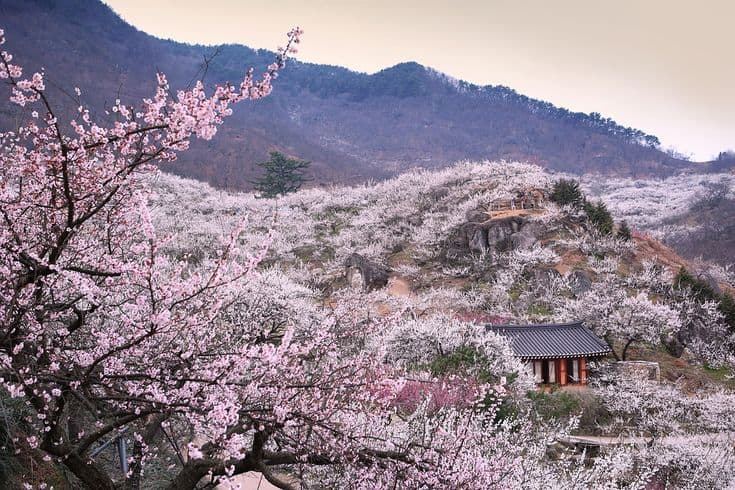
If there is one destination that truly defines Korea’s plum blossom season, it is Gwangyang Maehwa Village in South Jeolla Province. Set against the slopes above the Seomjin River, the village transforms into a breathtaking wash of white and pale pink as thousands of plum trees bloom across the hillsides. It is widely considered Korea’s first major spring flower destination and regularly hosts the Gwangyang Maehwa Festival, one of the country’s signature early-spring events. For 2026, the festival is listed for March 13–22, though bloom timing can shift slightly with the weather.
What makes Gwangyang so special is its atmosphere. Unlike the urban excitement of Seoul’s cherry blossom spots, this is a more scenic, almost cinematic experience, with misty hills, riverside views, winding village roads, and the kind of floral landscape that feels painted rather than planted.
Best Viewing Window
Plan your visit for early to mid-March, with the first half of March usually offering the strongest bloom conditions in the south. In warmer years, flowering can begin in late February.
Also Worth Visiting
If you want a more traditional and serene plum blossom experience, Changdeokgung Palace in Seoul offers a very different mood. The contrast between historic palace architecture and early spring blooms makes it ideal for travelers who want floral beauty without leaving the capital.
Late March to Early April: Cherry Blossoms – Korea’s Most Iconic Spring Spectacle
If plum blossoms are spring’s first whisper, cherry blossoms are its grand entrance. Cherry blossom season in Korea is fast, emotional, and gloriously photogenic. The blooms arrive in waves first in the warmer southern regions, then gradually moving north toward Seoul and beyond. Timing is everything, and the best strategy is to follow the bloom line upward through the country.
In 2026, multiple bloom trackers and tourism guides indicate a slightly earlier-than-average season, especially in southern Korea, though exact peak dates always depend on late-March temperatures.
Stop One: Jinhae – Korea’s Cherry Blossom Capital
If you want the full cinematic cherry blossom fantasy, go to Jinhae.
Every spring, this port district in Changwon becomes the center of Korea’s blossom obsession during the famous Jinhae Gunhangje Festival, one of the country’s largest and most beloved flower festivals. For 2026, major listings place the festival from March 27 to April 5. Jinhae is not just one cherry blossom spot it’s an entire destination built around bloom-chasing. The two must-visit highlights are:
1. Yeojwacheon Stream
This is the romantic, postcard-perfect side of Jinhae. Cherry trees line the stream in dreamy clusters, creating a floral tunnel that feels especially magical in the evening when lights reflect on the water.
2. Gyeonghwa Station
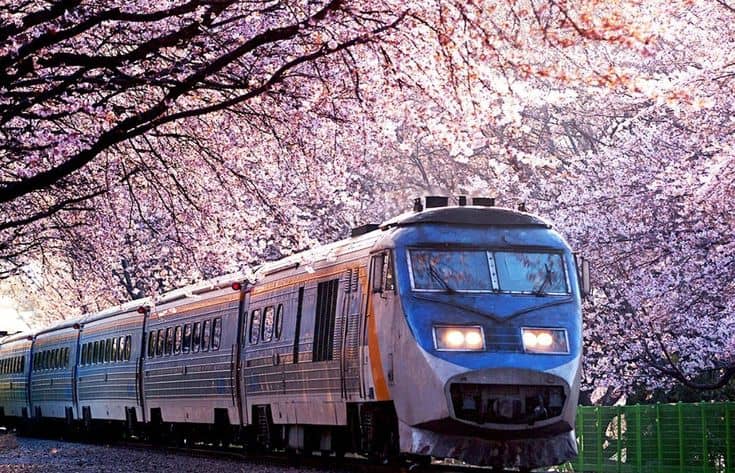
Perhaps one of Korea’s most iconic spring visuals, this former railway area is famous for its blossom-covered tracks. When petals begin to fall, the entire place takes on that soft “flower rain” look that appears in travel reels and K-drama edits.
Best Viewing Window
For Jinhae, the sweet spot is usually late March to the first week of April, with full bloom often hitting around the festival dates.
Stop Two: Seoul’s Yeouido – Urban Spring at Its Most Beautiful
If Jinhae is Korea’s romantic floral escape, Yeouido is spring in the city at its most iconic.
Located along the Han River in Seoul, Yeouido’s Yunjung-ro / Yeouiseo-ro is one of the capital’s best-known cherry blossom stretches. During the Yeongdeungpo Yeouido Spring Flower Festival, the road becomes a lively corridor of blooming trees, festival lights, and spring crowds. For 2026, festival listings place it around April 8–12.
What makes Yeouido so beloved is the contrast: soft pink blossoms against modern Seoul’s skyline, riverside paths, and urban energy. It is ideal for travelers who want to combine flower viewing with café-hopping, picnics, and a classic afternoon on the Han River.
Best Viewing Window
In Seoul, cherry blossoms generally peak from early to mid-April, with some 2026 forecasts suggesting around April 3–10 as the prime window depending on temperature shifts.
Bonus Seoul Tip
If Yeouido feels too crowded, consider Seokchon Lake or palace areas for a different cherry blossom mood. Yeouido is the energetic, classic pick, but not the only one.
Early April to Early May: Tulips – Korea’s Boldest Spring Color Story
After the soft whites and pinks of early spring, Korea shifts into something brighter and more dramatic: tulip season.
If cherry blossoms are all about fleeting beauty, tulips are about impact. Saturated reds, yellows, purples, oranges, and pinks turn entire gardens into painterly landscapes.
Best Place to See Them: Taean World Tulip Festival
Located in Anmyeondo, Taean, the Taean World Tulip Festival is one of Korea’s most visually striking spring flower events. It is often included in Korean spring travel roundups as a standout April destination, and 2026 community-travel tracking lists it from April 1 to May 6.
Unlike the wild, natural beauty of cherry or plum blossoms, Taean feels curated and immersive. The flower beds are designed for visual impact, with carefully arranged color blocks, themed garden paths, and a much more “festival garden” aesthetic.
Best Viewing Window
The best time to visit is usually mid-April, when tulip fields are at their fullest, and the weather is pleasant enough for a relaxed day outdoors.
Late March to May: Canola Flowers – Jeju’s Golden Spring Dream
And then comes the final flourish: canola season.
If Korea’s mainland spring is all about soft blossom romance, Jeju Island brings sunshine, wind, and bold yellow landscapes. The island’s canola fields are among the most recognizable spring visuals in Korea, especially when paired with volcanic scenery, coastal roads, and wide-open skies.
Best Place to See Them: Jeju’s Noksan-ro Canola Flower Road
One of the most famous spring drives on the island is Noksan-ro, a long scenic route where bright yellow canola flowers bloom alongside cherry blossoms in places, creating one of Korea’s most joyful seasonal landscapes. Korea tourism listings note it as one of Jeju’s signature spring routes, especially from late March to early April, with the nearby Jeju Canola Flower Festival scheduled for April 4–5, 2026, at Jeju Horse Park.
Jeju’s canola fields don’t feel like formal flower festivals in the same way as Seoul or Taean. They feel freer, more open, and more atmospheric—perfect for slow drives, roadside stops, and spontaneous photography.
Best Viewing Window
Canola season on Jeju generally stretches from late March into April, with some areas still looking lovely into early May depending on location and weather.
Spring in Korea Is More Than Sakura
Cherry blossoms may be the most photographed symbol of Korean spring, but they are only one chapter of the story.
The real beauty of the season lies in its progression, how plum blossoms arrive with stillness, how cherry blossoms explode with emotion, how tulips bring joy, and how Jeju’s canola fields stretch spring into something golden and windswept.
To experience spring in Korea fully is to follow that rhythm. Not just to see flowers, but to watch the country change color week by week. And honestly? That may be even more beautiful than cherry blossoms alone.
Article Compiled & Written By: Trisha Deka
About the Author –

Think of Trisha as your modern-day storyteller for a dynamic culture. She’s got a sharp eye for the moments where tradition and hyper-modernity collide in Korea. One minute, she’s breaking down the latest digital trends from Seoul, and the next, she’s explaining the timeless ritual of a tea ceremony. Her writing is your front-row ticket to understanding not just the “what” of Korean culture, but the “why” that makes it so captivating.