
The Taegeukgi, the National flag of South Korea, is more than a political symbol. It reflects Korea’s philosophical roots, historical struggles, and national identity. Designed in the late 19th century, the flag embodies ideas from East Asian philosophy while also representing Korea’s desire for independence and harmony. Over time, the Taegeukgi has become a powerful symbol of unity and resilience for the Korean people.
1. Philosophical Roots in Yin and Yang:
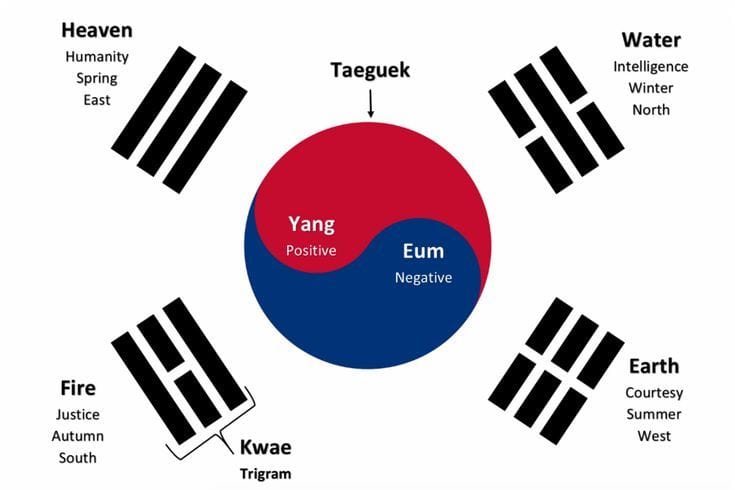
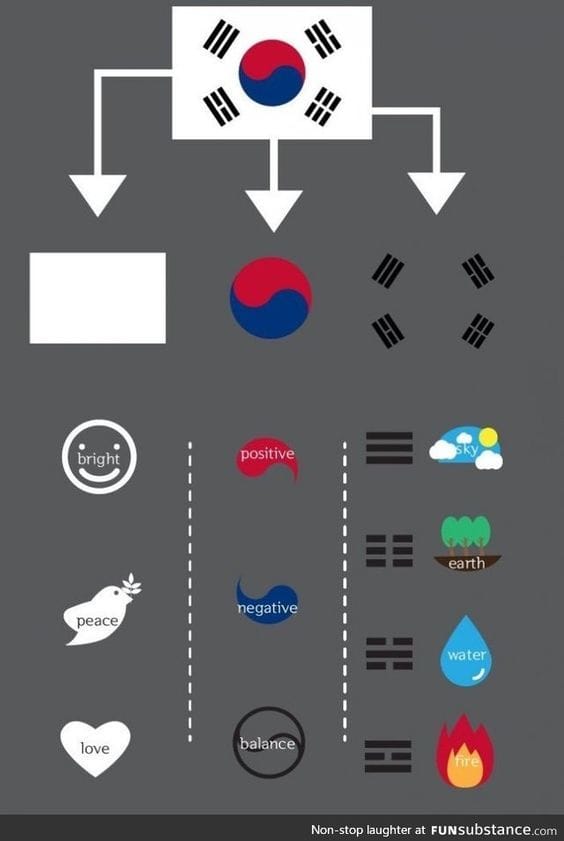
At the center of the Taegeukgi is the Taegeuk symbol, divided into red and blue halves. This comes from the ancient philosophy of Yin and Yang, which represents balance and harmony in the universe. The red portion symbolizes positive forces such as light and activity, while the blue represents negative forces like darkness and rest. Together, they express the belief that opposing forces coexist and complement each other, a core idea in Korean thought.
2. Influence of the I-Ching and Trigrams:
Surrounding the Taegeuk are four black trigrams taken from the I Ching (Book of Changes). Each trigram represents a natural element and a principle of life: heaven, earth, fire, and water. They also symbolize virtues such as justice, wisdom, and vitality. Their placement shows continuous change and balance, reflecting how Koreans view the relationship between humans and nature.
3. Creation During a Time of National Crisis:
The Taegeukgi was first created in 1882, a period when Korea faced intense pressure from foreign powers. The flag emerged as a symbol of sovereignty when Korea sought to assert itself as an independent nation. Choosing philosophical symbols instead of royal imagery helped present Korea as a unified and culturally rich country rather than one defined only by its rulers.
4. Symbol of Resistance and Independence:
During the Japanese colonial period (1910–1945), the Taegeukgi became a symbol of resistance. Korean independence activists carried it during protests and movements, most notably the March 1st Movement in 1919. The flag came to represent the Korean people’s determination to regain freedom and protect their identity despite oppression.
5. Modern Meaning and National Unity:
After South Korea was officially established in 1948, the Taegeukgi was adopted as the national flag. Today, it is displayed during national holidays, sporting events, and moments of remembrance. Beyond politics, it represents unity, peace, and the enduring spirit of the Korean people in both everyday life and times of crisis.
The Taegeukgi represents Korea through a blend of philosophy, history, and national struggle. Its symbols express balance, harmony, and resilience, values that have shaped Korean identity for centuries. From its origins in ancient philosophy to its role in modern nationhood, the Taegeukgi stands as a powerful reminder of Korea’s past and its hopes for the future.
Written by: Sneha chhabra
About the author –
Hello, I’m Sneha. I’m studying at Delhi University and learning Korean at KCCI. I’m really into languages, culture, and discovering new things about Korea every day. Whatever I learn – from grammar to little cultural details – I love sharing it in a simple, real, and relatable way. This journey means a lot to me, and I hope people can grow and learn with me.