
If you’re an Indian millennial or Gen-Z kid, chances are you’ve been caught up in the Korean wave at some point. Maybe you stayed up until 3 AM binging Crash Landing on You, or you know all the members of BTS, or you’ve got a Samsung phone in your pocket right now. Korean culture is everywhere in India these days. But here’s what most people don’t realize: while we’re obsessing over K-dramas and K-pop, there’s a massive economic relationship happening in the background that’s worth way more than all those entertainment exports combined.
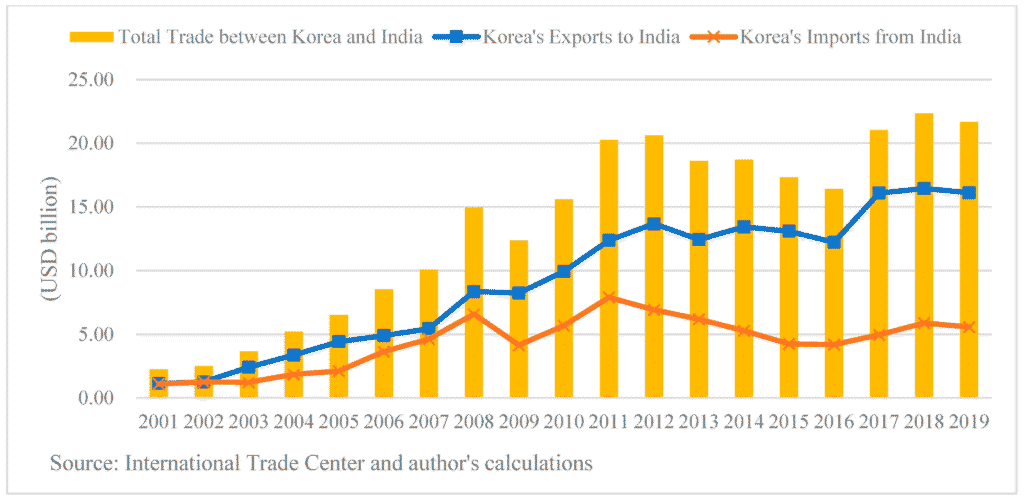
India and South Korea have been officially friendly since 1973, but the real business partnership kicked off in the 2000s. Today, we’re talking about roughly $27-28 billion in trade between the two countries every year. Sounds impressive, right? Except there’s a catch. India buys way more stuff from Korea than Korea buys from us. We’re running a pretty hefty trade deficit, which basically means we’re spending more than we’re earning in this relationship.
So what exactly are we buying from Korea? Sure, there are the obvious things. Look around your house and you’ll probably spot a Samsung TV, an LG fridge, maybe a Hyundai parked outside. Korean consumer brands are massive in India. But that’s actually the small stuff. The real action is in what economists call “intermediate goods” and industrial products. Korea ships us tons of steel and iron that goes into building our roads, bridges, and buildings. They send us sophisticated car parts for the Hyundais and Kias being assembled here. And here’s the big one: all those fancy electronic components that India’s trying to manufacture locally? A lot of them still come from Korea. We’re talking semiconductors, display screens, the high-tech guts that go into smartphones and computers.
Now, what are we sending back to Korea? Honestly, it’s a bit of a reality check. We export a lot of raw materials: aluminum, iron ore, coal, that kind of thing. Our refineries send them petroleum products. Korean grocery stores stock Indian rice and spices. We do export some higher-value stuff too, like pharmaceuticals and chemicals, which is good. But it’s still not enough to balance the books.
But wait, the story gets more interesting when you look beyond just buying and selling. Korean companies have poured over $6 billion into setting up shop in India. Samsung’s got this absolutely massive phone factory in Noida that they claim is the biggest in the world. Hyundai’s Chennai plant doesn’t just make cars for Indians, it exports them all over the place. When you think about it, this makes the whole “trade” thing more complicated. Is it really a Korean export if a Hyundai made in Chennai gets sold in Mumbai? These companies are weaving themselves into India’s economy in ways that simple trade numbers don’t capture.
The official line from both governments is that our economies “complement” each other perfectly. Korea’s got cutting-edge technology, manufacturing know-how, and money to invest. India’s got over a billion people who want to buy stuff, lots of young workers, and we’re pretty good at IT and making medicines. In 2010, both countries signed this big trade deal called CEPA to make it easier to do business together. The idea was that we’d both benefit from our different strengths. But more than ten years later, we’re still running that trade deficit, which makes you wonder if things are really as balanced as everyone says.
There are some tensions, naturally. Indian steelmakers and chemical companies sometimes complain that Korean imports are hurting their business. Politicians who like to talk about “Made in India” aren’t thrilled about the trade gap. On the flip side, Korean companies doing business here will tell you it’s not always easy. Our bureaucracy can be a nightmare, the infrastructure isn’t always reliable, and the rules seem to change without warning sometimes.
Here’s something most people miss: the services side of things. Indian IT companies are eyeing opportunities in Korea’s tech sector. Korean firms want Indian software developers and business services. And weirdly enough, all that K-pop and K-drama stuff is actually helping the business side. There are Korean language classes popping up all over Indian cities now. Kids who grew up watching Korean shows are learning the language, and some of them will end up working for Korean companies or helping Indian businesses work with Korea. Cultural soft power turns into economic opportunity.
Both governments know they need to fix the imbalance. India wants to sell Korea more finished products, not just raw materials. There are some promising areas coming up: green energy technology, digital infrastructure, maybe even defense equipment. The semiconductor thing is particularly interesting. India desperately wants to make its own computer chips, and Korea’s one of the best in the world at it. But getting that kind of technology transfer to happen is complicated. These companies guard their secrets closely, and setting up a chip factory costs billions of dollars.
Look, the India-Korea economic relationship is messy and complicated, like most real-world economics. Yes, K-pop is fun and K-dramas are addictive, and they definitely make Indians feel more positive about Korea. But the actual relationship is built on boring stuff like steel shipments, car parts, and semiconductor components. Twenty-seven billion dollars is a lot of money, but both countries could be doing even more together if they figured out how to make it more balanced.
The next time you’re scrolling through Instagram and see some Indian kid dancing to a Blackpink song on their Samsung phone, just remember: behind that moment is this whole complicated world of international trade, factory investments, and economic policy that affects way more people than any viral video ever will. That’s the real India-Korea relationship, and it matters a lot more than we usually give it credit for.
Written by – Kimaya Ambekar
About the Author –
Hello! I am Kimaya. I’m someone who enjoys capturing ideas and moments through writing. I love exploring new topics, learning something interesting, and turning it into a clear, enjoyable read. Writing lets me express myself and share things in a way that feels natural and fun.